Monday, May 9, 2011

Conclusion

The Brazilian Economy is similiar to the United States Economy in its ambition for economic growth and its attempt to cut spending after the hard hitting recession. Although their is a trade imbalance within the country, Brazil's economic growth is estimated to grow 4% over the course of 2011-2012. This South American country is on the rise along with its number one trading partner, China. The United States needs to keep this country close if it wants to retain hegemony.

Rouseff Fiscal Restraint--Cut Spending and Reduce High Real Interest Rate

http://www.easybrazilinvesting.com/macroeconomics/82-world-bank-expects-brazilian-gdp-to-grow-44-in-2011-and-43-in-2012.html


"First, Brazil clearly went through a particularly acute case of the “political business cycle”, the well documented tendency for governments to ramp up spending before elections. The recent increases in big spending, first justified as an anti-cyclical, “Keynesian” response to the 2008 crisis, continued unabated even with economic growth topping 7 per cent a year. Now with the election won, there is no electoral reason to keep spending growth at the current level. The second unrecognized reality is that this spending surge is already causing serious imbalances in the economy. This can already be seen in very tight labor markets, surging imports, and continued high inflation for non-tradable items.

...

Fiscal restraint is the key element of a new economic “model” for Brazil, and although changing fiscal policy is always slow and difficult, the incentives to do so now are great. As Rousseff knows, an economic crisis is the one sure way to lose political power."

Tony Volpon of Nomura


Brazil + China = BFFs?

http://blog.securities.com/2011/04/brazils-trade-with-china/

exports to China grew 47%
imports from China grew roughtly 38% (from 1999-2010)

Brazil has overtaken the United States as China's largest trading partner since 2009. China accounts for approxomately 15% of Brazil's trade flow.

brazil-china-trade.jpg


Leading exports to China include: iron ore, soybeans, and crude oil. The iron ore export represents 43% of Brazil's total exports to China.

Some problems are evident between this trade relationship; a large portion of Brazil's imports from China are manufactured products, set at low costs, which affect Brazil's domestic manufacturing industries (that are now struggling to keep up with this competition).

A few tariffs on synthetic fibres imports from China have been put in place by the government and President Dilma Rousseff.

Banking System

http://coinmill.com/BRL_USD.html

The Brazilian Real is the currency in Brazil (BR, BRA).
Also known as Reals.
The symbol for BRL can be written R$.
The Brazilian Real is divided into 100 centavos.

1.61 BRL = 1.00 USD

Like the United States, Brazil's banking system has been technologized; however, Brazilian ATM's allow citizens the oppurtunity to pay any bill and print full account statements and blank checks.
Interest rates are very high in Brazil. For example, the interest rate for credit card balances hovers between 8% and 10+% per month and heaven help you if your payment is ever late (over 30 days) because the rate increases by an additional 50%.

Wednesday, March 23, 2011

GDP: Brazil, United States, & China (in trillions)

United States China Brazil
1990 $5.76 $0.36 $0.46
1991 $5.94 $0.38 $0.41
1992 $6.29 $0.42 $0.39
1993 $6.61 $0.44 $0.44
1994 $7.03 $0.56 $0.55
1995 $7.36 $0.73 $0.77
1996 $7.78 $0.86 $0.84
1997 $8.28 $0.95$0.87
1998 $8.74 $1.02 $0.84
1999 $9.30 $1.08 $0.59
2000 $9.90 $1.20 $0.64
2001 $10.23 $1.33 $0.55
2002 $10.59 $1.45 $0.50
2003 $11.09 $1.64 $0.55
2004 $11.81 $1.93 $0.66
2005 $12.58 $2.26 $0.88
2006 $13.34 $2.71 $1.09
2007 $14.06 $3.49 $1.37
2008 $14.37 $4.55 $1.64
2009 $14.12 $4.99 $1.57

Thursday, March 10, 2011

Brazil posts fourth-quarter growth of 5% GDP may cool to 4.5%-5% range in 2011

LOS ANGELES (MarketWatch) — Brazil’s economy in 2010 grew at its fastest yearly rate in nearly 25 years, but expansion in Latin America’s largest economy showed signs of a slowdown in the final quarter

Brazil's Market

Definitions and Examples

1. Perfect Competition: An idealized market structure in which there are large numbers of both buyers and sellers, all of them small, so that they act as price takers. Perfect competition also assumes homogeneous products, free entry and exit, and complete information.

Ex.)

2. Oligopoly: a market situation in which each of a few producers affects but does not control the market

Ex.) Brazil's Steel Sector is an oligopoly.

3. Monopoly: exclusive ownership through legal privilege, command of supply, or concerted action

Ex.) BM&FBOVESPA has a monopoly over securities, commodities, and future exchanges.

4. Monopolistic Competition: form of imperfect competition where many competing producers sell products that are differentiated from one another (that is, the products are substitutes, but, with differences such as branding, are not exactly alike).

Ex.)

Amazon Basin and Rainforrest Animals

http://www.unique-southamerica-travel-experience.com/amazon-rainforest-animals.html

spider-monkey-5.jpg

SPIDER MONKEY


giant-otter_542_600x450.jpg

GIANT RIVER OTTER


the-capybara.jpg

CAPYBARA


Toucan-with-Cicada_jpg.jpg

TOUCAN


Pink+Dolphin.jpg

PINK RIVER DOLPHIN


electriceel.jpg

ELECTRIC EEL


piranha.jpg

PIRANHA


Anaconda_Photos.jpg

anaconda2.jpg

ANACONDA

Thursday, March 3, 2011

Urban vs. Rural Life

Brazil 2 largest cities (Rio de Janeiro and Sao Paulo) boast some of the largest populations in urban environments around the globe; both cities are in the top 25 largest cities in the world. Brazil's large cities face overpopulation, poverty, and slums (also known as flavelas). Most employees in the urban areas work for banks, hotels, factories, office buildings, or stores.

The rural environment is extremely different; the land in Brazil is vast, so much of the land is unpopulated. Most rural inhabitants work on large plantations or ranches. Poverty is a major issue in the rural areas, as in the urban counterparts. Many workers can barely feed their families and abject impoverishment is rampant.

Sociocultural Values

Religion: 7o% Roman Catholic, 15% Protestant
Ecclesial Base Communities are a prominent form of devotion.

Patrimonialism: traditional system domination of society of a strong state with a centralized bureaucracy.

List of Brazilian holidays and festivals: http://gosouthamerica.about.com/cs/brazil/l/blholidays.htm


Almonds, Gabriel A., G. Bingham Powell Jr., Russell J. Dalton, Kaare Strom.Comparative Politics Today: A World View. New York: Longman, 2010. p. 512.

Political Structure

Presidential System:
President Dilma Rousseff

Bicameral Legislature:
Congress--> Senate and Chamber of Deputies

Governors in Federal Districts: includes Legislative Assemblies for each region (26 states in the Federal District--Rio de Janeiro)

Local Governments:
Mayors and City Counsels

Almonds, Gabriel A., G. Bingham Powell Jr., Russell J. Dalton, Kaare Strom. Comparative Politics Today: A World View. New York: Longman, 2010. p. 512.

Demographics

Population

201,103,330
note: Brazil conducted a census in August 2000, which reported a population of 169,872,855; that figure was about 3.8% lower than projections by the US Census Bureau, and is close to the implied underenumeration of 4.6% for the 1991 census (July 2010 est.)

Age structure

0-14 years: 26.7% (male 27,092,880/female 26,062,244)
15-64 years: 66.8% (male 65,804,108/female 67,047,725)
65 years and over: 6.4% (male 5,374,230/female 7,358,082) (2010 est.)

Median age

total: 28.9 years
male: 28.1 years
female: 29.7 years (2010 est.)

Population growth rate

1.166% (2010 est.)

Birth rate

18.11 births/1,000 population (2010 est.)

Death rate

6.35 deaths/1,000 population (July 2010 est.)

Net migration rate

-0.09 migrant(s)/1,000 population (2010 est.)

Urbanization

urban population: 86% of total population (2008)
rate of urbanization: 1.8% annual rate of change (2005-10 est.)

Sex ratio

at birth: 1.05 male(s)/female
under 15 years: 1.04 male(s)/female
15-64 years: 0.98 male(s)/female
65 years and over: 0.73 male(s)/female
total population: 0.98 male(s)/female (2010 est.)

Infant mortality rate

total: 21.86 deaths/1,000 live births
male: 25.39 deaths/1,000 live births
female: 18.15 deaths/1,000 live births (2010 est.)

Life expectancy at birth

total population: 72.26 years
male: 68.7 years
female: 76 years (2010 est.)

Total fertility rate

2.19 children born/woman (2010 est.)

Ethnic groups

white 53.7%, mulatto (mixed white and black) 38.5%, black 6.2%, other (includes Japanese, Arab, Amerindian) 0.9%, unspecified 0.7% (2000 census)

Religions

Roman Catholic (nominal) 73.6%, Protestant 15.4%, Spiritualist 1.3%, Bantu/voodoo 0.3%, other 1.8%, unspecified 0.2%, none 7.4% (2000 census)

Languages

Portuguese (official and most widely spoken language); note - less common languages include Spanish (border areas and schools), German, Italian, Japanese, English, and a large number of minor Amerindian languages

Literacy

definition: age 15 and over can read and write
total population: 88.6%
male: 88.4%
female: 88.8% (2004 est.)

School life expectancy (primary to tertiary education)

total: 14 years
male: 14 years
female: 14 years (2008)

Education expenditures

5.2% of GDP (2007)

http://www.indexmundi.com/brazil/demographics_profile.html

Wednesday, March 2, 2011

Brazilian History

In the early 16th century, the Portuguese, led by explorer Pedro Cabral, landed in what is modern brazil. The Portuguese began their exploration in search of goods for European trade and land to improve their economic statuses in Portugal. The majority of the explorers were less interested in territorial dominion and more interested in making a profit back in Europe. However, when sugar reached Brazil, the Portuguese began to import slaves and the land was colonization began in 1534 under Dom Joao III. Rio de Janeiro was captured from the French in 1567 and Sau Luis in 1615. Sugar exports began to decline at the close of the 17th century, which led to Portuguese discovery and lucrative trade of gold in the region called Minas Gerais.

In 1807, Napoleon Bonaparte of France invaded the capitol of Portugal, Lisbon. The Portuguese government reestablished the seat of the empire across the Atlantic Ocean in Rio de Janeiro. King Joao VI returned to Lisbon in 1821 and relinquished his rule of Brazil to his son Prince Pedro. The Portuguese government attempted to return Brazil to its colonial state, but Prince Pedro, alongside the Brazilians, opposed this decision. On September 7, 1822, Brazil became an independent country and on October 12, 1822, Prince Pedro became the first emperor of Brazil and his coronation was held on December 1, 1822. The Monarchy was overthrown in 1889, although Pedro II remained the head of state.

The early republic was equivalent to a military dictatorship headed by Pedro II, but the 1930s weakened this long standing regime. Getulio Vargas led a revolution and overthrew President Washingont Luis and established himself as president. In 1937, Brazil transformed into a full dictatorship under Vargas; but he was overthrown in 1945 at the end of World War II and General Eurico Dutra was elected and assumed presidency in 1946. However, this was short-lived and Vargas gained control again in 1951. He was unable to govern properly with an active democracy and committed suicide in 1954.

Since then, Brazil has become and returned from dictatorships. The current and 36th president of Brazil is Dilma Rousseff; she assumed office on January 1, 2011 and is the first woman to hold the title of president in Brazil.


Monday, February 7, 2011

Brazil's Two Largest Cities


SAO PAULO


POPULATION: APPROX. 11.2 MILLION


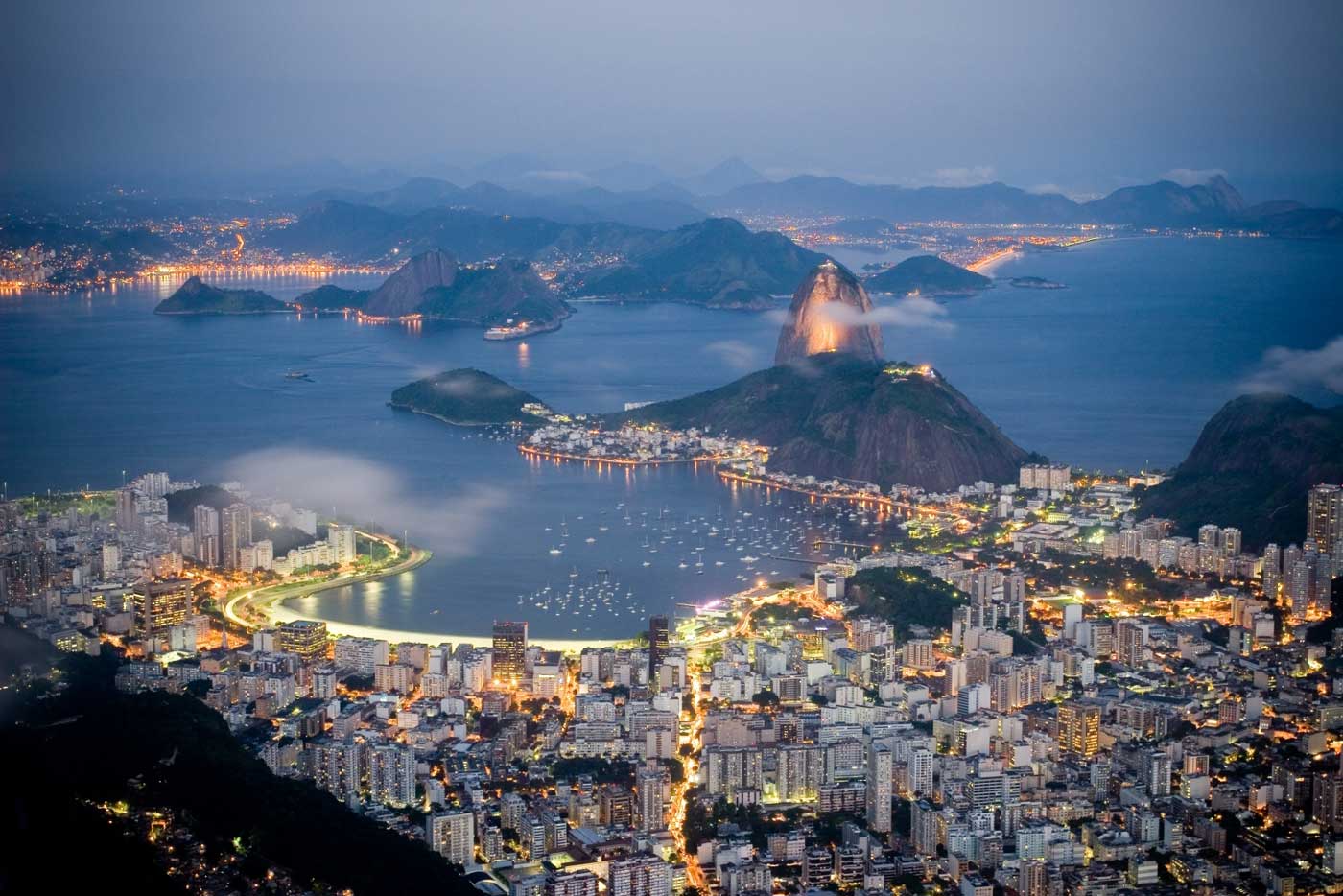
RIO DE JANEIRO


POPULATION: APPROX. 6.3 MILLION

Geography/Economic Geo

The climate and geography of Brazil is vast; the "Amazon River system carries more water to the ocean than any other river system in the world" (Rosenburg). The basin and Amazon jungle are home of the most rapidly diminishing rainforest in the world. Sixty percent of Brazil is covered by the rainforest, which is why the country is very humid and has a tropical/subtropical climate. While most of the country has a wet climate, the eastern highlands and plateaus suffer from frequent droughts. The highest point in the Brazilian highlands is Pico de Nablina, whose summit is at 9888 feet.

The most populous state of Brazil is Sao Paulo and Rio de Janeiro, the cultural and international transportation capital, is the second; however, the capital is Brasilia. The population of Sao Paulo has "doubled since 1977" and continues to grow. Sao Paulo also retains half of Brazil's GDP and two-thirds of the country's manufacturing. Roughly a third of the world's coffee production comes from Brazil. The country is also known for its citrus, cattle, iron ore, and sugar cane production, although the chief industry of Brazil is automobile production.

Rosenburg, Matt. "Geography of Brazil." Web.

Friday, January 28, 2011

This blog will follow the economic position of Brazil in the winter/spring of 2011. My purpose for this blog is to improve my knowledge of Brazil's fiscal activity as well as to inform others about this South American, economically expanding country. I want to encourage readers to contribute and comment freely.

LB

Thursday, January 27, 2011

26 states of Brazil. 5 Regions: North, Northeast, Central-West, Southeast, South.

Search This Blog